Primary colors
The primary colors are red, yellow and blue in paint; red, green and blue in light. You can't mix them from other colors, but you can mix almost every other color from them.
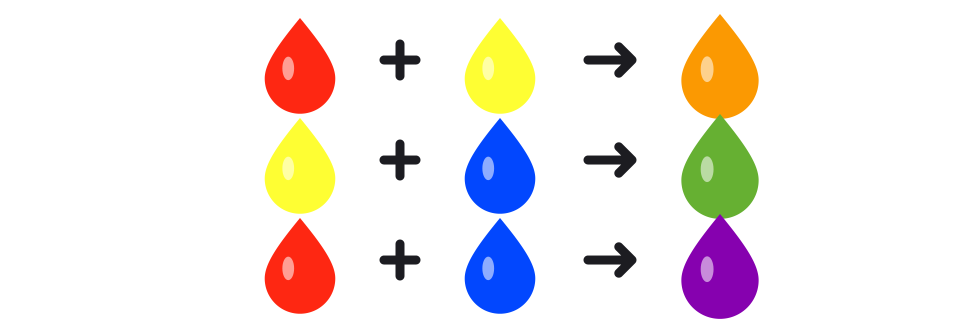
1 × Red + 1 × Yellow
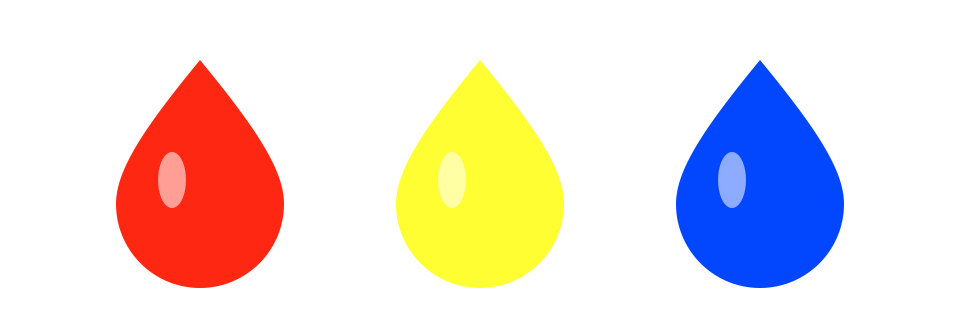
Three kinds of primary colors
| system | primary colors | used for |
|---|---|---|
| Paint (RYB) | red, yellow, blue | art class, painting |
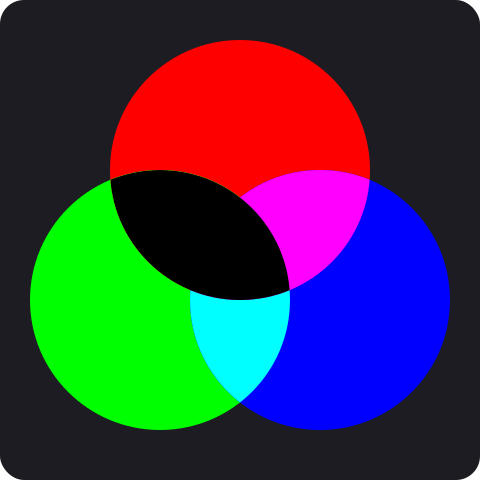
| Light (RGB) | red #FF0000, green #00FF00, blue #0000FF | screens, phones, stage lights |
| Ink (CMY) | cyan #00FFFF, magenta #FF00FF, yellow #FFFF00 | printers |
Printables
Primary colors worksheet
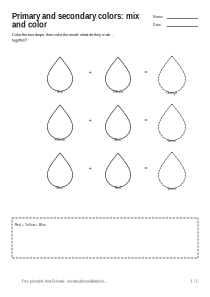
Primary and secondary colors: mix and color
For teachers
For teachers
Lesson in 3 steps: 1. Show the three paint drops and ask which colors children see. 2. Mix two primaries in the demo and let children predict the result first. 3. Hand out the worksheet: children color the primaries, then mix the secondaries with real paint. Takes about 30 minutes.
What are the primary colors?
Primary colors are the starting colors of a color system. You can't make them by mixing other colors, but by mixing them you can make most other colors. In art class and painting, the three primary colors are red, yellow and blue. Mix two of them and you get a secondary color: red and yellow make orange, yellow and blue make green, red and blue make purple. Mix all three and you get brown.
The three primary colors of light
Screens work differently. A phone or a TV makes colors by shining tiny lights, and its primary colors are red, green and blue (RGB). Light adds up: red and green light make yellow, green and blue make cyan, red and blue make magenta, and all three together make white. That is why a screen can show yellow without any yellow light at all.
Primary colors for printing
Printers use a third set: cyan, magenta and yellow (CMY), plus black ink (K) for crisp text and deep shadows. These are the "true" primaries of mixing pigments, because they give the widest range of colors. In fact, the red and blue of a school paint set act like magenta and cyan. That is why some art teachers now teach cyan, magenta and yellow as the primaries.
Common questions about primary colors
Is black a primary color? No. In paint, black is what you get when colors absorb almost all light, and you can mix a near-black from the primaries. In light, black is simply no light. White is not a primary either: in light, it is all colors together; in paint, it must come from a tube, but it doesn't make new hues. Some people speak of four primary colors, adding green to red, yellow and blue, because our eyes and brains see four "pure" hues. For painting and school, three primaries are enough.
You can also make brown from primary colors: mix red, yellow and blue in about equal parts. Try it in the demo above.
Questions and answers
What are the three primary colors?
Red, yellow and blue in paint; red, green and blue in light; cyan, magenta and yellow in printing.
What are the three primary colors of light?
Red, green and blue (RGB). Together they make white.
Is black a primary color?
No. Black can be mixed from the primaries in paint, and in light it is the absence of light.
Can you make brown from primary colors?
Yes. Mix red, yellow and blue in about equal parts.
Are there 4 primary colors?
Some systems add green, because our vision has four "pure" hues. In painting, the three primaries are red, yellow and blue.
What are the true primary colors?
For mixing paints and inks, cyan, magenta and yellow give the widest range. For light, red, green and blue.