Color theory
Color theory explains how colors mix and which colors look good together. It starts with the color wheel: 3 primary, 3 secondary and 6 tertiary colors.
Learn
- Primary colors: the three colors that make all the others.
- Secondary colors: what you get when you mix two primaries.
- Tertiary colors: a primary mixed with the secondary next to it.
- Warm and cool colors: the colors of fire and sun against the colors of water and ice.
- Tints, shades and tones: a color with white, black or gray added.
- RYB vs RGB: why paint and screens mix differently.
- Color meanings: what each color makes us feel, in design and in life.
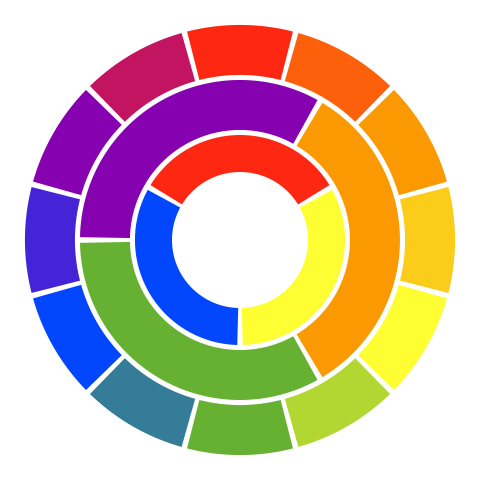
Inner ring: the primaries red #FE2712, yellow #FEFE33 and blue #0247FE. Middle ring: the secondaries orange #FB9902, green #66B032 and violet #8601AF. Outer ring: the tertiaries red-orange, yellow-orange, yellow-green, blue-green, blue-violet and red-violet.
Printables
Color theory quiz with answers
What color theory is
Color theory is a set of simple ideas that explain how colors mix and how they work together. Painters, designers, decorators and photographers use it every day, often without thinking about it. Its main tool is the color wheel, a circle of colors in rainbow order that shows how colors relate: which mix into which, which contrast, which blend.
The ideas are old. Isaac Newton bent the rainbow into a circle in the 1700s; Goethe wrote about how colors make us feel; Albert Munsell built a system that measures colors by hue, value (lightness) and chroma (strength), still used today. In the 1960s, the artist Josef Albers showed with simple squares that a color looks different depending on the colors around it. Today, designers add the science of screens and light, the RGB model.
The color wheel in 3 rings
Start in the middle with the three primary colors of paint: red, yellow and blue. Mixing two primaries gives a secondary color: orange, green and violet. Mixing a primary with the secondary next to it gives one of six tertiary colors, such as red-orange or blue-green. Together they make the 12-color wheel that schools and artists use; the interactive wheel above shows it with labels.
Color theory in practice
Colors opposite each other on the wheel, called complementary, give the strongest contrast. Neighbors, called analogous, look calm together. The wheel also splits into warm colors (reds, oranges, yellows) and cool colors (greens, blues, violets). Adding white makes a tint, black a shade, gray a tone. With these few ideas you can choose colors for a painting, a room, an outfit or a website, and the harmony rules on this site turn them into palettes in one click. For clothes, the same rules work: pair a color with its neighbor for a calm outfit, or with its opposite for one bold accent.
Questions and answers
What is color theory?
A set of ideas about how colors mix and which colors look good together, built around the color wheel.
What are the basics of color theory?
The color wheel, primary, secondary and tertiary colors, harmonies (complementary, analogous, triadic), warm and cool colors, and tints, shades and tones.
Who invented color theory?
Many people shaped it: Newton made the first color circle, Goethe wrote about color and feeling, Munsell built a color system, and Josef Albers taught how colors affect each other.
What is the Munsell color system?
A way to describe colors by hue, value (lightness) and chroma (strength), used in art, science and industry.