Analogous colors
Analogous colors are 3 to 5 neighbors on the color wheel, such as red #FE2712, red-orange #FC600A and orange #FB9902. They look calm and natural together.
Free·No sign-up·Works offline after the first visit
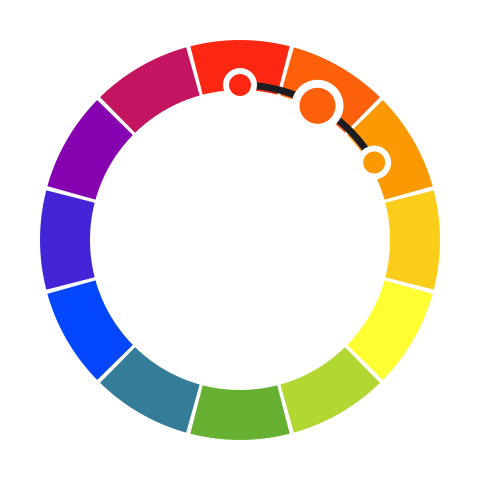
Neighbors 30° apart. Drag a small handle to spread them from 15° to 60°.
Analogous sets on both wheels
| artist wheel (RYB) | screen wheel (RGB) |
|---|---|
| red #FE2712, red-orange #FC600A, orange #FB9902 | red #FF0000, orange #FF8000, yellow #FFFF00 |
| yellow #FEFE33, yellow-green #B2D732, green #66B032 | yellow #FFFF00, chartreuse #80FF00, green #00FF00 |
| green #66B032, blue-green #347C98, blue #0247FE | green #00FF00, spring green #00FF80, cyan #00FFFF |
| blue #0247FE, blue-violet #4424D6, violet #8601AF | cyan #00FFFF, azure #0080FF, blue #0000FF |
| violet #8601AF, red-violet #C21460, red #FE2712 | blue #0000FF, violet #8000FF, magenta #FF00FF |
| Artist wheel (RYB) | Screen wheel (RGB) |
|---|---|
Analogous colors
Sunset
#6B1E2E #C0392B #E67E22 #F5B041 #FCE8C8
Forest walk
#1E4D2B #3E7C48 #7FA65A #C8D98F #F1F4E6
Ocean
#0B3C5D #1B6F8A #2A9D8F #8FD3C9 #EAF6F4
Lavender field
#3D2C5E #6A4C93 #967BB6 #C9B8E8 #F3EEFA
Citrus
#F3722C #F8961E #F9C74F #DCE775 #FFFBEA
Berry
#5E1742 #962E6F #C75D86 #E9A2C0 #FBE7F0
- Backgrounds and large areas that should feel calm, such as a website hero or a bedroom wall.
- Nature and wellness brands: greens with blue-greens, or warm earth tones.
- Illustration and landscapes, where light shifts gently from warm to cool.
- Add one complementary accent when the scheme feels too quiet.
What analogous colors are
Analogous colors are colors that sit side by side on the color wheel. A scheme usually takes three of them, sometimes five: one main color, the neighbor on each side, and lighter or darker versions. Because neighbors share a hue (orange holds some red and some yellow), they blend without any clash. That makes analogous schemes the easiest harmony to get right.
The definition in short: analogous colors are adjacent colors on the wheel, within about 90° of each other. Go further and you start to get contrast instead of harmony.
Examples in art and design
Nature is full of analogous schemes. A sunset runs from red through orange to yellow; a forest from yellow-green to blue-green; the sea from green-blue to deep blue. Monet's water lily paintings are mostly blues, blue-greens and violets. In design, many calm brands use them: green and teal for health, blue and violet for tech.
In a room, analogous colors make a space feel restful. Paint the walls a soft sage, add olive cushions and a blue-green throw, and keep wood and white as neutrals. To avoid a flat look, vary lightness: one light color for the walls, a middle one for furniture, a dark one in small amounts.
RYB vs RGB for this rule
Analogous sets look similar on both wheels, because neighbors stay neighbors. The difference is in the steps: the artist wheel has more room for warm colors (red to yellow fills a third of the wheel), while the screen wheel gives more room to greens and cyans. If your colors are for paint or a classroom, use the artist wheel; for screens, try both and keep the one you like.
Questions and answers
What are analogous colors?
Colors next to each other on the color wheel, such as yellow, yellow-green and green.
What is an example of an analogous color scheme?
Red, red-orange and orange, like a sunset; or green, blue-green and blue, like the sea.
How many colors are in an analogous scheme?
Usually three, sometimes up to five neighbors, plus a neutral such as white or gray.
Do analogous colors work in a room?
Yes. They feel calm; vary light and dark, and add one accent from the other side of the wheel if it feels flat.