Split complementary colors
A split complementary scheme takes one color and the two colors next to its opposite. For red #FE2712: yellow-green #B2D732 and blue-green #347C98.
Free·No sign-up·Works offline after the first visit
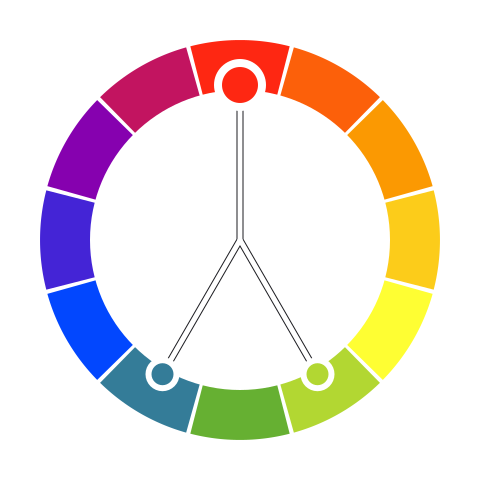
The base color and the two neighbors of its opposite, 150° away on each side.
Split complementary sets on both wheels
| base | artist wheel (RYB) | screen wheel (RGB) |
|---|---|---|
| red | #FE2712 + yellow-green #B2D732 + blue-green #347C98 | #FF0000 + spring green #00FF80 + azure #0080FF |
| blue | #0247FE + yellow-orange #FCCC1A + red-orange #FC600A | #0000FF + chartreuse #80FF00 + orange #FF8000 |
| yellow | #FEFE33 + blue-violet #4424D6 + red-violet #C21460 | #FFFF00 + azure #0080FF + violet #8000FF |
| green | #66B032 + red-violet #C21460 + red-orange #FC600A | #00FF00 + rose #FF0080 + violet #8000FF |
| Artist wheel (RYB) | Screen wheel (RGB) |
|---|---|
Split complementary colors
Coral and teal
#FF7F50 #2A9D8F #3D5A80 #F7F3EE
Navy with warm accents
#1F2A44 #F4A261 #E76F51 #F4F1EA
Plum, lime and gold
#5E2750 #9BC53D #E3B505 #FAF7F0
Garden
#2D6A4F #D1495B #EDAE49 #F8F4E3
Sky and rust
#4A90C2 #C8553D #F2A65A #FFFDF8
Berry and sage
#8E244D #9CAF88 #5B8E7D #F6F1EB
- When you want the punch of complementary colors with less tension.
- Websites: a cool main color with two warm accents for buttons and highlights.
- Painting: the double split (two neighbors on each side) adds more range for skies and shadows.
What split complementary colors are
Split complementary is a variation of the complementary scheme. Instead of the color directly opposite your base, you take the two colors on either side of that opposite. On the wheel the three colors form a narrow Y or an isosceles triangle. You keep strong contrast between the base and the other two, but the two accents are softer neighbors of each other, so the result is easier on the eye.
It is often recommended to beginners, because it is hard to get wrong: almost any base color gives a pleasant, lively set.
Examples in art and design
A painting of a red barn in yellow-green fields under a blue-green sky is split complementary. Many websites use a blue brand color with yellow-orange and red-orange accents for buttons and badges. In a living room, a navy sofa with apricot and rust cushions follows the same rule.
A double split complementary scheme uses two pairs: the neighbors of the base and the neighbors of its opposite. It gives four colors and needs a clear lead color, like the tetradic scheme.
RYB vs RGB for this rule
The rule is the same on both wheels, but the colors differ because the opposites differ. Red's split on the artist wheel lands on yellow-green and blue-green; on the screen wheel on spring green and azure, both around red's RGB opposite, cyan.
Questions and answers
What is a split complementary color scheme?
A base color plus the two colors next to its complement, such as red with yellow-green and blue-green.
What is an example of split complementary colors?
Blue #0247FE with yellow-orange #FCCC1A and red-orange #FC600A.
What is a double split complementary scheme?
Four colors: two neighbors of the base and two neighbors of its opposite.
Is split complementary better than complementary?
It is softer and easier to balance, while complementary gives the strongest contrast.